 $6.99
New
$6.99
New
Home › Templates › Finance › Remit
Finance dashboard template
Remit Invoicing Dashboard Template
Remit is a single-file HTML dashboard for invoicing and receivables: aging, a sortable invoice register, client payment behavior, and an 8-week cash outlook.
Remit is an accounts receivable dashboard template for a freelancer, studio, or small agency. It is one self-contained HTML file with four tabs, Receivables, Invoice Register, Client Accounts, and Cash Position, rendering the July 2026 books of the fictional Fern and Webb Design Studio, reconciled to the bank on July 9.
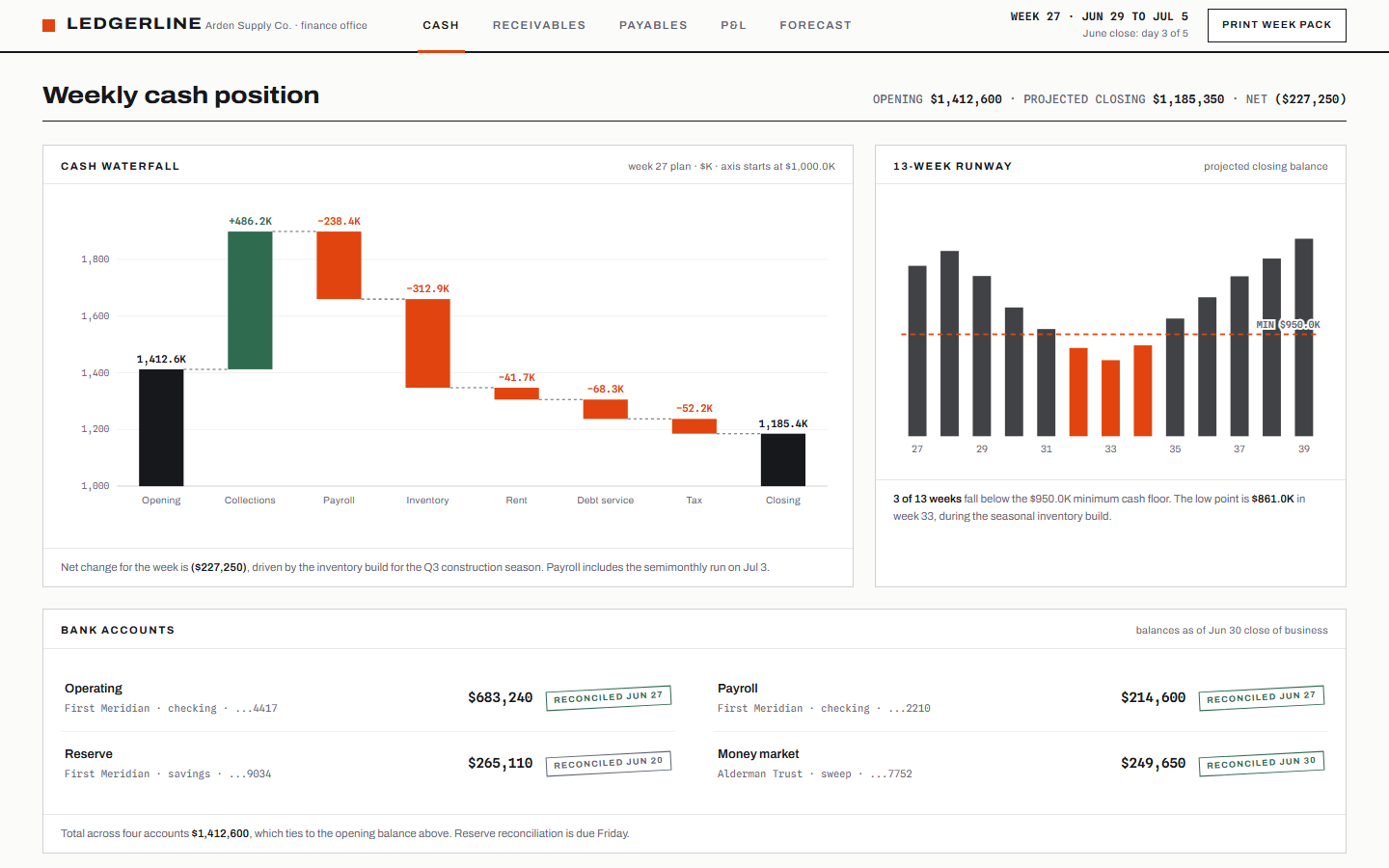
Remit's Receivables tab opens with three figures: $48,260 outstanding across 11 open invoices, $14,900 overdue with the oldest 47 days past, and a 23-day median time to payment against net-30 terms. An aging waterfall shows where the money sits across 5 buckets, and a chase list ranks the 3 past-due invoices oldest first with send-reminder actions and a written cadence: day 3 nudge, day 14 call, day 30 late fee, day 60 pause work. The Invoice Register lists 11 invoices with number, client, work description, amount, issued and due dates, and rotated rubber-stamp statuses, DRAFT, SENT, OVERDUE, PAID, sortable by clicking the column headers. Client Accounts charts trailing 12-month revenue by client, with Meridian Grocers at $68,400 and 38% of the total, beside a payment behavior table of median days to pay per client with plain-language reads, and a concentration note that sets the goal of bringing the top client under 30%. Cash Position projects expected cash for the next 8 weeks, haircut by client behavior, with runway math that puts $31,400 in the bank against $19,800 of monthly burn and a week-5 low-water mark of $24,100.
What is inside Remit
- Three headline figures: $48,260 outstanding across 11 open invoices, $14,900 overdue, and a 23-day median time to payment
- Aging waterfall in 5 buckets showing where the outstanding money is stuck
- Chase list of the 3 past-due invoices, oldest first, with days-past counts and send-reminder actions
- Written reminder cadence: day 3 nudge, day 14 call, day 30 late fee, day 60 pause work
- Sortable invoice register with rubber-stamp status labels: DRAFT, SENT, OVERDUE, PAID
- Trailing 12-month revenue bars by client with each client's share of the total
- Payment behavior table with median days to pay per client and plain-language reads
- Concentration note flagging the top client at 38% of revenue against a 30% goal
- Expected cash chart for the next 8 weeks, haircut by client payment behavior
- Runway math panel: $31,400 in the bank against $19,800 of monthly burn, with the week-5 low-water mark
Who Remit is for
Remit serves studio owners and freelancers, who check the Receivables tab before committing to new work, seeing exactly who owes what and how late the oldest invoice runs.
Bookkeepers work the chase list and the reminder cadence, and queue month-end statements for every client with an open balance from the Cash Position tab.
Agency operations managers watch client concentration and payment behavior, deciding which accounts get prepay terms based on median days to pay.
Fractional CFOs use the 8-week expected cash chart to time payroll and rent against collections that are haircut by each client's payment history.
When to reach for it
Remit fits anyone whose invoice tracker is a spreadsheet opened nervously before payroll. The template turns it into a fixed page: outstanding, overdue, and days-to-paid on top, the chase list beside the aging chart, no re-sorting by hand.
It fits the Friday cash check. The expected-cash chart and runway math answer whether next month's burn is covered without opening accounting software, and the Kestrel scenario shows how one chased invoice changes the week-5 margin.
It also makes client concentration visible. When one account passes a third of trailing revenue, the concentration note says so in plain language and states the pipeline goal that fixes it.
Specifications
| Format | Single self-contained HTML file; zero dependencies, no build step |
|---|---|
| Theme | Letterhead Blue |
| Mood | Light |
| Category | Finance |
| Price | $6.99, one-time |
Frequently asked questions
Who is this template for?
Remit is for anyone who invoices clients and chases payment personally: freelancers, design studios, small agencies, consultants. The sample data is a design studio with 7 active clients on net-30 terms, and the whole layout assumes you run the books yourself rather than an accounting department.
Does it send real reminders or statements?
No, Remit does not send real reminders or statements: the send-reminder and queue-statements buttons demonstrate the workflow with toast confirmations, but nothing leaves the browser. The template is the front end; wiring it to email or an invoicing API is your integration job.
How is the expected cash chart calculated?
The expected cash chart lands each open invoice in the week of its due date, then haircuts the total by that client's payment history. The sample data makes the logic visible: week 6 is empty unless the Kestrel chase lands, and the chart note says exactly that.
Can I change the currency or payment terms?
Yes, you can change the currency or payment terms: amounts are plain numbers formatted by one usd helper, so switching currency means editing that function. The reminder cadence, aging buckets, and terms text are strings and array values near the top of the script.