 $6.99
New
$6.99
New
Home › Templates › Support › Queue
Support dashboard template
Queue Contact Center Dashboard Template
Queue is a single-file HTML wallboard for a contact center: live queue stats, interval charts, agent states, call drivers, QA scores, and Erlang staffing gaps.
Queue is a contact center dashboard template delivered as one self-contained HTML file. It shows the wallboard view of a fictional operation, Northwind Support, on a Tuesday at the 10:30 interval: 14 callers in queue with a longest wait of 6:12, service level at 72% against an 80%-in-30-seconds target, 9 of 26 agents ready, and an abandon rate of 4.1% against a target under 5%. Five tabs cover the floor: Intervals, Agents, Call Drivers, Quality, and Forecast & Staffing.
The Intervals tab charts offered vs handled calls by half hour with service level printed under each interval, and annotates the 10:00 spike where offered volume jumped 41% against forecast because of a billing portal timeout. The Agents tab is a sortable board with state, handled count, AHT, ACW, and adherence per agent. The Call Drivers tab ranks dispositions in pareto order and pairs them with a deflection ledger showing what self-serve absorbed, for example the password-reset flow containing 84% of its sessions while the billing FAQ contains only 31%. The Quality tab holds a QA scorecard for week 28 with a 3-evals-per-agent minimum, a 6-week CSAT trend, and a calibration note. The Forecast & Staffing tab compares tomorrow's Erlang-staffed requirement against the published schedule and shades the coverage gaps.
What is inside Queue
- Four wallboard KPIs: in queue now (14, longest wait 6:12), service level (72% vs 80% in 30s), agents ready (9 of 26), and abandon rate (4.1% vs under 5%)
- Half-hour interval chart of offered vs handled calls with service level printed under each interval
- Annotated spike analysis tying a 41% offered jump at 10:00 to a billing portal timeout disposition
- Sortable agent board with state, handled, AHT, ACW, adherence vs schedule, and coaching notes
- Call drivers chart ranking the week's dispositions in pareto order
- Deflection ledger with sessions, containment rate, and estimated calls avoided per self-serve surface
- QA scorecard for the week with evals, score, and weakest section per agent, plus a calibration note
- Six-week CSAT trend from post-contact 5-point surveys
- Tomorrow's forecast vs scheduled chart with Erlang-staffed intervals and shaded coverage gaps
- Coverage gap table with need vs have per interval and an overtime action for the standby list
Who Queue is for
Queue serves contact center managers, who watch the header KPIs and the interval chart to decide when to pull agents off breaks or switch on callback offers.
Workforce planners use the Forecast & Staffing tab, where Erlang-derived need vs scheduled have makes the 11:00 pinch and its overtime fix explicit.
Team leads use the agent board and QA scorecard for coaching, with adherence, AHT, and weakest QA section per agent.
Operations analysts use the call drivers pareto and the deflection ledger to argue that fixing the billing FAQ page shrinks the phone queue.
Quality leads use the calibration note to keep scoring consistent across the team.
When to reach for it
Queue fits contact centers that have telephony data but no wallboard. The template replaces a TV stuck on a spreadsheet with a page built to be read from across the room.
It fits the intraday management rhythm: the 10:00 spike annotation shows how the board ties a service level dip to a root cause and a response in one glance.
It also replaces the weekly WFM export deck, since tomorrow's forecast vs schedule and the coverage gaps table already live on the Forecast & Staffing tab.
Specifications
| Format | Single self-contained HTML file; zero dependencies, no build step |
|---|---|
| Theme | Wallboard Teal |
| Mood | Light |
| Category | Support |
| Price | $6.99, one-time |
Frequently asked questions
What is the difference between Queue and Switchboard?
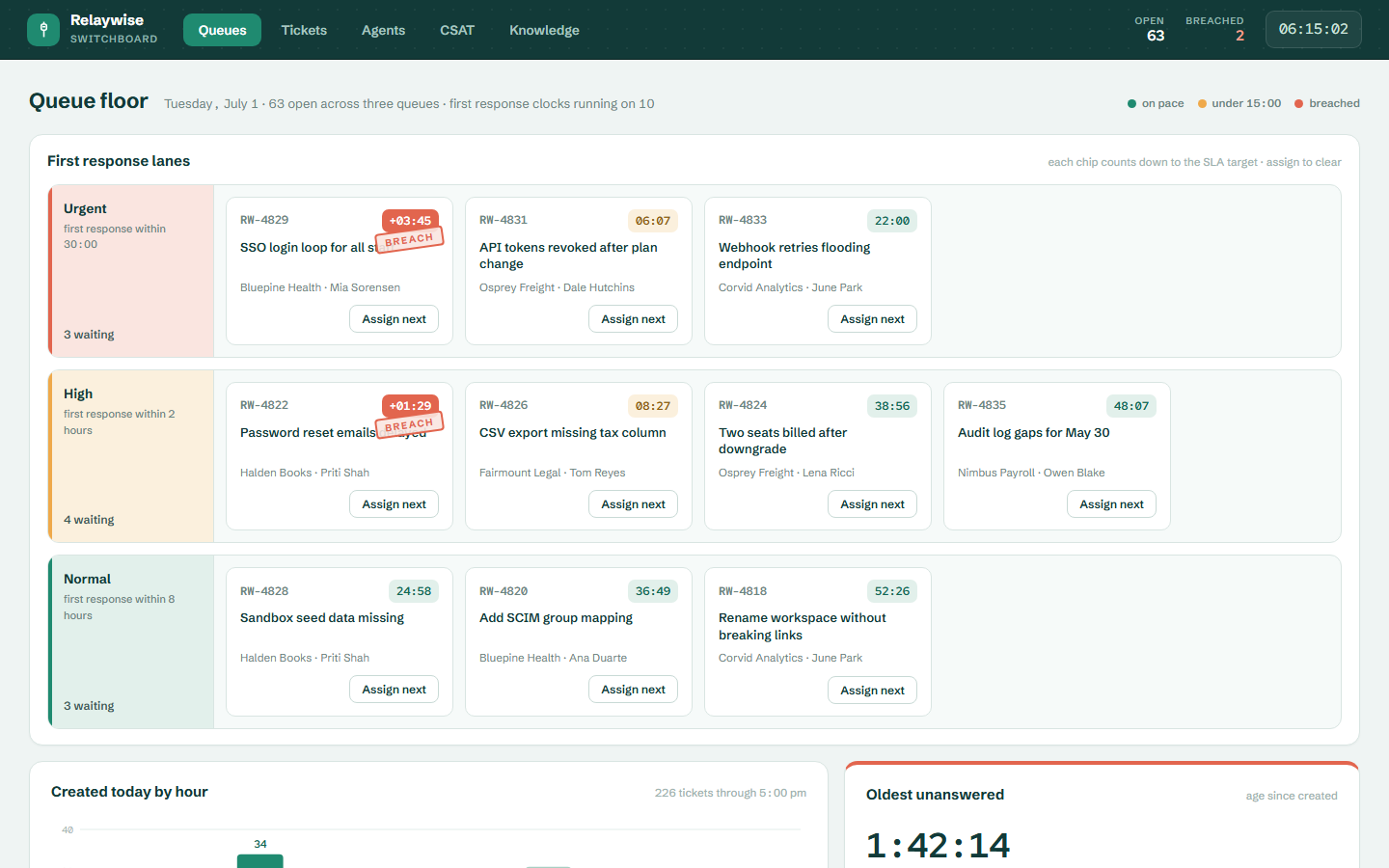
Queue is built for phone-style contact centers: intervals, service level in 30 seconds, AHT, ACW, adherence, and Erlang staffing. Switchboard is built for ticket-based helpdesks: SLA first response lanes, ticket tables, and a knowledge base. Both are in the support category.
Does Queue show live telephony data?
No, Queue does not show live telephony data. Queue ships as a static HTML file with realistic sample data for one day of intervals. You update the arrays in the file from your ACD exports. The layout is designed like a wallboard, so a scheduled refresh script can republish it to a screen.
What does the deflection ledger measure?
The deflection ledger measures how much each self-serve surface contains: it lists sessions, containment rate, and estimated calls avoided per surface. In the sample, the password-reset flow contains 84% of sessions while the billing FAQ contains 31%, which explains why billing remains a third of the phone queue.
How is the staffing forecast calculated?
The staffing forecast is calculated as Erlang-staffed intervals: required agents per half hour compared against the published schedule, with gaps shaded. The sample data is precomputed; you replace the need and have arrays with output from your own WFM tool.