 $6.99
$6.99
Home › Templates › Logistics › Slipstream
Logistics dashboard template
Slipstream Airline Operations Dashboard Template
Slipstream is a single-file HTML dashboard template for airline ops, with a departures board, network map, rotations, crew control, and a disruption desk.
Slipstream is an airline operations dashboard template delivered as one self-contained HTML file. An airline operations dashboard shows whether the day's schedule is holding: departures on time, aircraft where they should be, crews inside duty limits, and what disruptions cost. Slipstream renders all of that across five views in a light Porcelain Navy theme with the accent #1F3A5F, modeling an ops day of 118 scheduled departures at a fictional hub, Boreal City YBR.
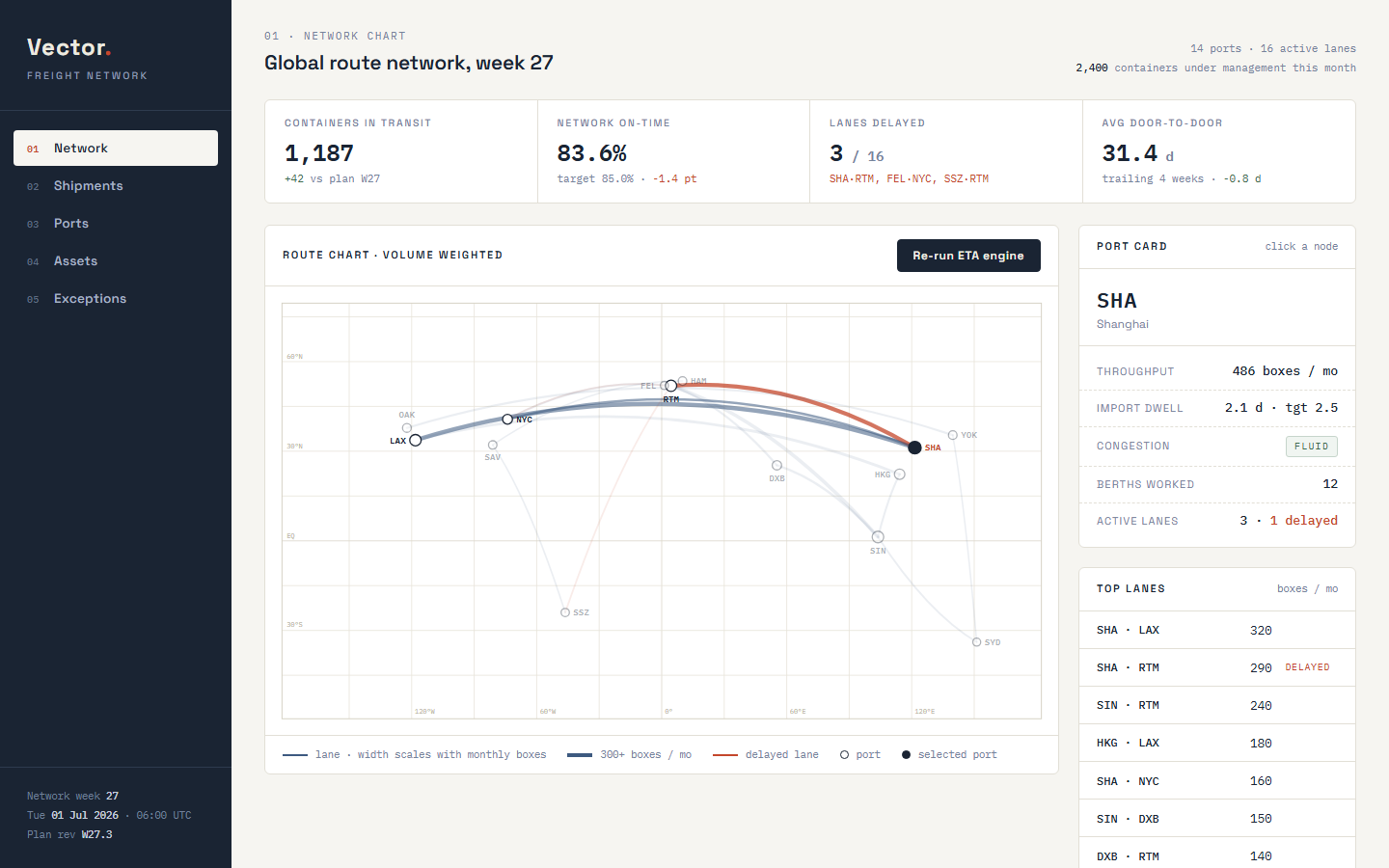
Slipstream opens on the Departures Board with three readout tiles: a Completion tile counting flights flown out of 118 with a progress bar, an On-Time Performance tile measured on a D15 basis against an 82.0% target with a delta in points, and an Active Delays tile with average and worst delay in minutes. The board itself lists Flight, Route, Tail, Gate, STD, EST, and Status for every departure, filters to delayed or cancelled, and opens a flight strip when you select a row. The Network Map draws 23 stations with route lanes weighted by today's frequency and toggles the overlay between frequency and punctuality, with a station card on click. Aircraft Rotations is a Gantt of 12 of 42 tails across three time windows, where flight blocks, hatched amber sub-minimum turns, hatched navy maintenance blocks, and a now line at 14:32 all read at a glance, and each tail opens an aircraft card. Crew Control holds a duty-time watchlist ranked by flight duty period hours remaining, filterable by base, plus reserve coverage against requirement, open time trips, and fatigue reports over a rolling 12 weeks. The Disruption Desk handles irregular operations: a delay Pareto by cause code that filters an affected flights list, a cost of disruption panel, cancellations with reaccommodation, and a misconnect forecast for YBR connections by bank with per-connection risk.
What is inside Slipstream
- Departures board for 118 flights with Flight, Route, Tail, Gate, STD, EST, and Status columns
- Readout tiles for day completion, on-time performance against an 82.0% target on a D15 basis, and active delays with average and worst minutes
- Status filter for all, delayed, and cancelled flights, with a flight strip detail per selected row
- Network map of 23 stations with frequency-weighted route lanes and a frequency-versus-punctuality overlay toggle
- Aircraft rotation Gantt for 12 of 42 tails across 3 time windows, with hatched sub-minimum turns, maintenance blocks, and a now line
- Crew duty-time watchlist ranked by flight duty period hours remaining, filterable by YBR, YKV, or YTN base
- Reserve coverage against requirement, open time trips, and fatigue reports over a rolling 12 weeks
- Delay Pareto by cause code (reactionary, weather, technical, crew, ATC) that filters the affected flights list
- Misconnect forecast for YBR connections by bank with inbound, connection, passenger count, connect time, and risk columns
Who Slipstream is for
Slipstream serves the operations controllers who run the Departures Board and Disruption Desk: they watch completion and OTP against the 82.0% target, drill into delayed flights, and work the misconnect forecast before the evening bank breaks. Duty managers use Aircraft Rotations to see which tail has a sub-minimum turn or a maintenance block, and Crew Control to see which pairing is running out of duty hours and whether reserve coverage meets requirement at each base. Network planners read the Network Map to see frequency and punctuality by station. An operations director gets the day in one pass: 118 departures, the OTP delta in points, active delays with the worst offender, and the cost panel.
When to reach for it
Slipstream is the pick when you are building for airline or aviation operations and the domain detail is the hard part. Duty period limits, D15 on-time measurement, cause-coded delay Paretos, and misconnect risk are not things a generic admin kit models; Slipstream models all of them with coherent sample data, like the weather event at YKV that shows up on the board, in the delay tile, and on the disruption desk. It suits an airline or ground handler prototyping an operations control center, a developer building a crew or disruption tool, or a consultant showing an aviation client what a working OCC screen feels like. The departures list generates from a seeded random function, so 118 realistic flights render every load, and swapping in a live flight status feed means replacing one data layer while the board, Gantt, and watchlist stay as they are.
Specifications
| Format | Single self-contained HTML file; zero dependencies, no build step |
|---|---|
| Theme | Porcelain Navy |
| Mood | Light |
| Category | Logistics |
| Price | $6.99, one-time |
Frequently asked questions
What does the Slipstream airline dashboard template track?
Slipstream tracks a full ops day: departures by status, on-time performance against an 82.0% target, aircraft rotations and turn times, crew duty hours against flight duty period limits, reserve coverage, delay causes, cancellation reaccommodation, disruption cost, and misconnect risk by connection bank.
How many flights and aircraft does the Slipstream sample data model?
The Slipstream sample data models 118 scheduled flights and 42 aircraft tails. The departures board lists the 118 flights for the ops day, generated from a seeded random function so they stay consistent between loads. The rotations view shows 12 of the 42 tails at a time across morning, afternoon, and evening windows, and the network map covers 23 stations.
Does Slipstream include crew duty and fatigue monitoring?
Yes, Slipstream includes crew duty and fatigue monitoring. Crew Control shows a watchlist of pairings ranked by flight duty period hours remaining, with used hours against each limit, report time, and rest notes. It also shows reserve coverage against requirement by base, unassigned open time trips, and fatigue reports over a rolling 12 weeks.
Is Slipstream a single HTML file with no dependencies?
Yes, Slipstream is a single HTML file with no dependencies. The board, map, Gantt, and Pareto are inline SVG and HTML drawn by the embedded script, and the only external request is the font. Open it in any browser and every filter, toggle, and drill-down works.