Home › Templates › Athletics
Category
Race and Event Dashboard Templates
A race and event dashboard template is a single HTML file that renders registration, course logistics, timing, and volunteer metrics for an endurance event in a browser. These metrics answer the questions a race director asks at the 06:00 sync during race week: which tasks are open, what the weather flags say, how full each distance is, and if the timing mats pass. This page lists one race operations template, a self-contained file you preview live, download free, and edit in any text editor.
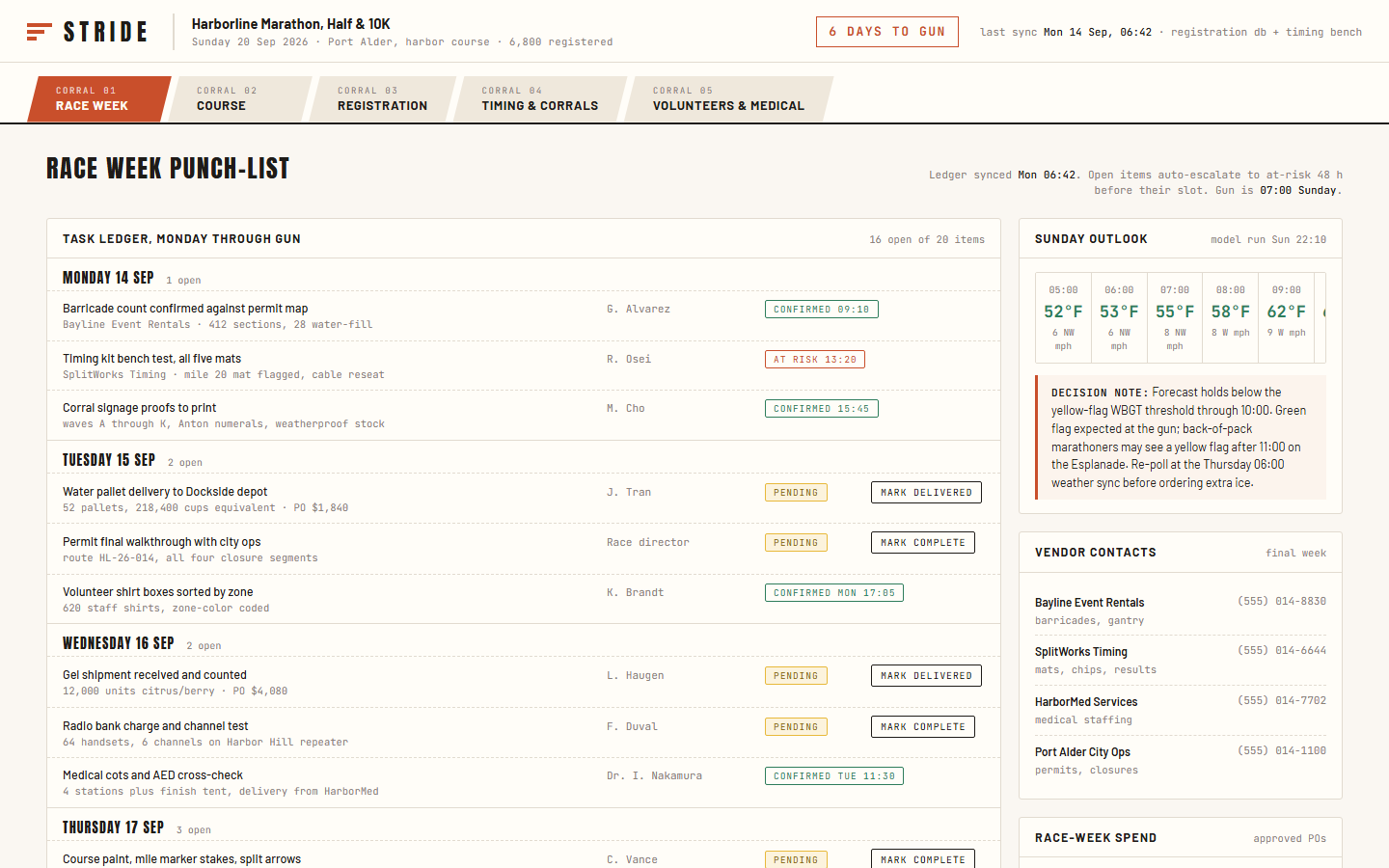
The template is Stride, which models the Harborline Marathon in Port Alder with 6,800 registered runners and 6 days to the gun. Stride opens on a race-week task ledger that auto-escalates open items to at-risk 48 hours before their slot, beside a weather outlook keyed to WBGT flag thresholds. The course section draws the 26.2-mile elevation profile with aid stations and timing mats marked per mile, plus road closures under city permit 26-1180. Registration tracks fill against cap by distance with 10 weeks of signup history. Timing commits to staging only when every mat reads at 99.5 percent or better. Volunteers and medical show 572 of 620 shift slots filled across 6 zones.
Compare the athletics templates
| Template | Domain | Theme | Price |
|---|
| Stride | Race ops, Endurance events | Track Orange | Free |
Who uses these
A race operations dashboard serves 5 roles: race directors, course managers, registration leads, timing coordinators, and volunteer coordinators. Race directors run the final week from one screen, with open tasks, weather flags, and approved spend in front of them. Course managers own aid stations, road closures, and cutoff enforcement across the 26.2-mile route. Registration leads watch fill against cap and process the transfer and deferral ledger, which stands at 34 transfers at $15 and 61 deferrals at $25 for the season. Timing coordinators test every mat against the 99.5 percent commit criterion before Friday staging. Volunteer coordinators track shift fill by zone and stage supplies at each medical station.
When to reach for one
A race operations template is the right pick when race week runs on a shared spreadsheet, a group chat, and a whiteboard. The console puts the punch-list, course, registration, timing, and volunteer picture on one page that every coordinator reads the same way. Pick it also to replace the printed operations binder, because permit numbers, cutoff times, and radio channels live in fixed sections that a volunteer with the file can reference as reliably as the race director. Stride is free in the catalog, so an event can trial the format for one race before investing in a custom ops platform. The chart choices behind the course profile and the signup history are covered in the guide to dashboard chart types.
Frequently asked questions
What is a race operations dashboard template?
A race operations dashboard template is a pre-built HTML page that displays race-week metrics such as open tasks, course logistics, registration fill, timing mat tests, and volunteer shift fill. You download one file, replace the sample data with your own event figures, and open it in any browser. No server, account, or build step is required.
Is there a free race dashboard template?
Yes, Stride is a free race dashboard template that renders the full race-week console for a marathon, half marathon, and 10K with sample data: task ledger, course profile, registration fill, timing board, and volunteer rosters. It uses the same single-file structure as the paid templates.
Can I adapt the race template for a 5K or a triathlon?
Yes, you can adapt the race template for a 5K or a triathlon, because every figure, distance, and table is data inside the single HTML file. Change the course length, corral structure, and aid station rows to fit your event, and the layout adjusts around your content.
Does the race template pull live data from a registration platform?
No, the race template does not pull live data from a registration platform. The shipped file renders static sample data stamped with a fixed sync time. Connecting a live registration database or timing system means replacing the embedded data with a fetch to your own feed, a contained scripting change.
 Dashboard
 Free
New
Stride is a single-file HTML dashboard template that tracks registration, course logistics, timing, and volunteers for a marathon race week.
race week task ledger with auto-escalation of open items to at-risk 48 hours before their slotweather outlook panel keyed to WBGT yellow and green flag thresholds with a re-poll decision notecourse profile chart showing elevation, closure windows, aid stations, and timing mats per mile
Download freeLive preview
Free
New
Stride is a single-file HTML dashboard template that tracks registration, course logistics, timing, and volunteers for a marathon race week.
race week task ledger with auto-escalation of open items to at-risk 48 hours before their slotweather outlook panel keyed to WBGT yellow and green flag thresholds with a re-poll decision notecourse profile chart showing elevation, closure windows, aid stations, and timing mats per mile
Download freeLive preview