Home › Templates › Crypto
Category
Crypto Trading Dashboard Templates
A crypto trading dashboard template is a single HTML file that renders positions, funding, liquidation risk, execution quality, and custody for a digital asset book in a browser. These metrics answer the questions a trading desk asks at every review: what the book holds, what the carry earns, how far liquidation sits, and where the coins are. This page lists one crypto trading template, a self-contained file at $6.99 that you preview live and edit in any text editor.
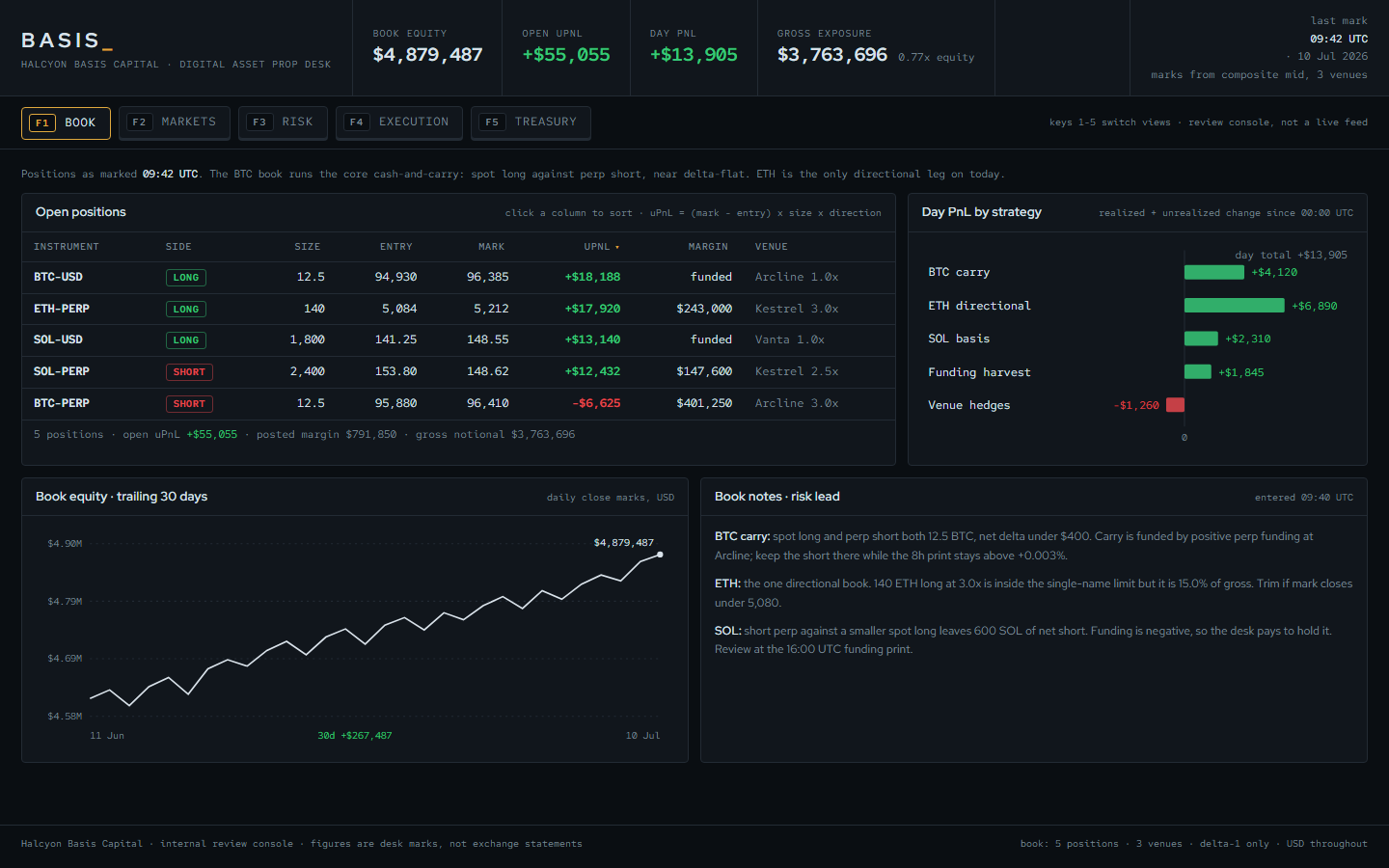
The template is Basis, styled like a terminal with function-key tabs F1 through F5: Book, Markets, Risk, Execution, and Treasury. Basis renders the book of fictional Halcyon Basis Capital at the 09:42 UTC mark, with 5 positions across 3 venues and delta-1 instruments only. The Book view centers on a BTC cash-and-carry, 12.5 BTC spot long against 12.5 BTC-PERP short, and computes unrealized PnL live on every render. The Risk view draws a liquidation ladder per perp leg and reports value at risk of $98,400 at 1-day 95% and $147,200 at 1-day 99%. Treasury splits custody between exchange and cold storage across 7 wallets under a 2-of-3 signing quorum.
Compare the crypto templates
| Template | Domain | Theme | Price |
|---|
| Basis | Digital assets, Trading desk | Charcoal Phosphor | $6.99 |
Who uses these
A crypto trading dashboard serves 4 roles: prop traders, desk risk leads, execution traders, and fund operations staff. Prop traders read Book and Markets for the state of the carry: funding per venue with 8-hour rates, annualized figures, and next-print countdowns. Risk leads work the Risk view, checking liquidation distances against the soft 50% and hard 75% limits before trusting the VaR cells. Execution traders review fill quality by instrument and venue, measured in basis points against arrival mid. Fund operations staff reconcile Treasury, confirming what sits on exchange versus cold storage and which of the 3 pending transfers await a second signer.
When to reach for one
A crypto trading template is the right pick when the desk picture is scattered across three exchange tabs and a spreadsheet. The template consolidates positions, funding, risk, execution, and custody into one review console keyed F1 to F5. Pick it also for the end-of-day or pre-open risk review, because the liquidation ladder, margin gauges, and VaR cells answer the questions that matter for a margined perp book. Developers building an internal trading tool use Basis as the front end, since positions, custody, markets, orders, and wallets are labeled arrays that a live feed can replace. For longer-horizon books, the adjacent Tranche venture fund template is a useful next read, and the HTML versus React dashboard templates comparison explains why a desk console ships as one file.
Frequently asked questions
What is a crypto trading dashboard template?
A crypto trading dashboard template is a pre-built HTML page that displays digital asset metrics such as open positions, funding rates, liquidation risk, execution quality, and custody balances. You download one file, replace the sample book with your own positions, and open it in any browser.
Is this a live trading terminal?
No, Basis is a review console with desk marks, not a live trading terminal, and the footer says so. The flatten action stages a simulated ticket behind a two-step confirm and routes nothing. It is the front end you would wire to real exchange APIs.
What instruments does the crypto template model?
The crypto template models spot and linear perpetuals only, which the risk view states plainly: there is no options book, so no greeks. The sample book runs a BTC cash-and-carry, an ETH directional long at 3.0x, and a SOL basis trade across three fictional venues.
How does the liquidation ladder work?
The liquidation ladder gives each perp leg an axis spanning entry, current mark, and liquidation price, with a shaded band for remaining margin distance. Hovering a row fills a detail line with that leg's margin arithmetic against the soft 50% and hard 75% limits.
 Dashboard
 $6.99
New
Basis is a single-file HTML console for a crypto trading desk: positions, funding, liquidation risk, execution quality, and custody across three venues.
desk header with book equity, open uPnL, day PnL, and gross exposure as a multiple of equityfunction-key tab strip, F1 to F5, with number-key shortcuts for the 5 viewssortable positions table where uPnL computes from entry, mark, size, and direction on every render
Buy now · $6.99Live preview
$6.99
New
Basis is a single-file HTML console for a crypto trading desk: positions, funding, liquidation risk, execution quality, and custody across three venues.
desk header with book equity, open uPnL, day PnL, and gross exposure as a multiple of equityfunction-key tab strip, F1 to F5, with number-key shortcuts for the 5 viewssortable positions table where uPnL computes from entry, mark, size, and direction on every render
Buy now · $6.99Live preview