Home › Templates › Agency
Category
Agency Dashboard Templates
An agency dashboard template is a single HTML file that runs a studio's client work from one screen. Client work means projects with deadlines, tasks with owners, a client list with lifetime spend, and the messages that tie them together. This page lists 1 agency template, a self-contained file you preview live, buy for $6.99, and edit in any text editor.
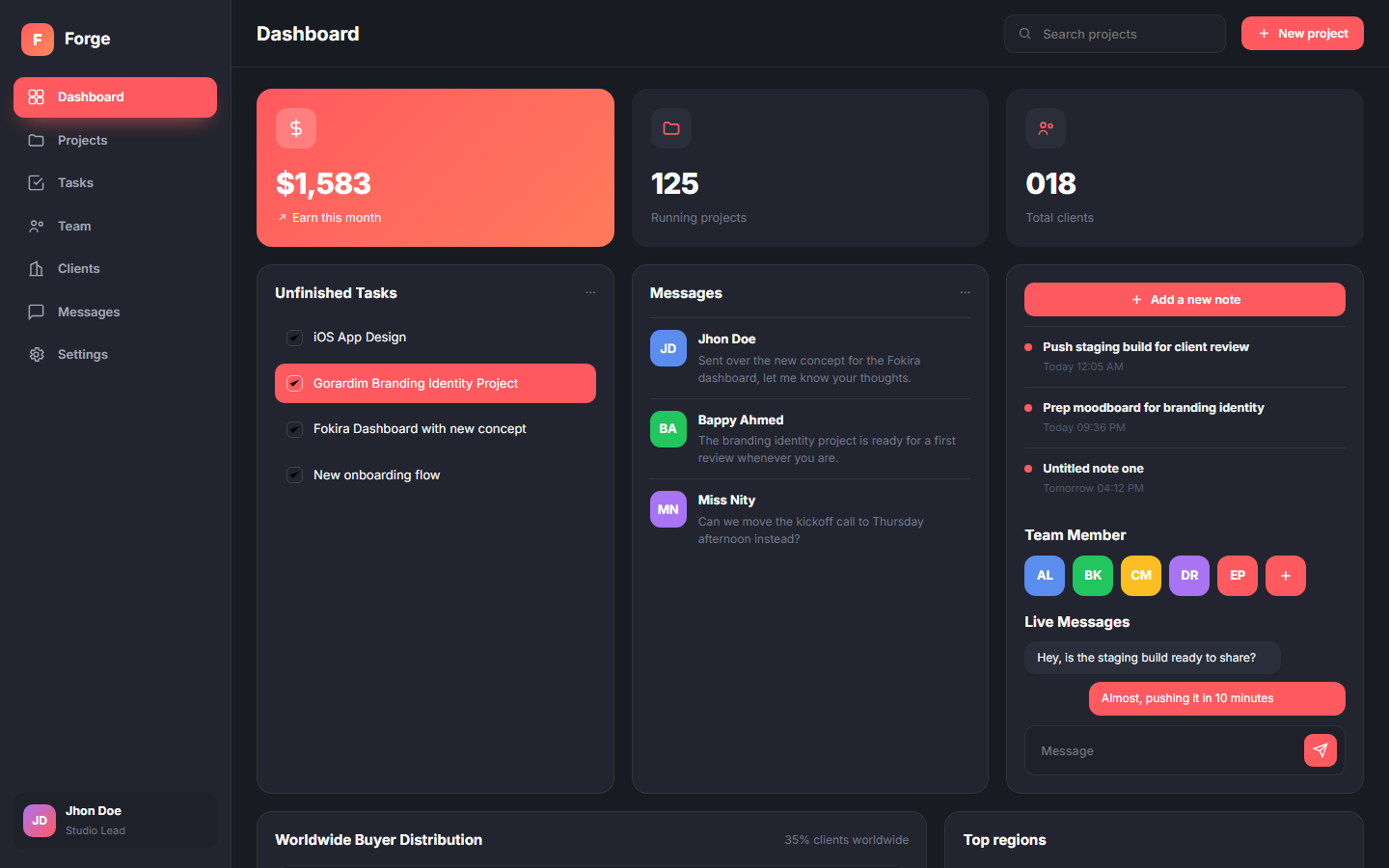
The template is Forge Studio, a dark agency operations dashboard organized into 7 views: Dashboard, Projects, Tasks, Team, Clients, Messages, and Settings. The Dashboard view opens with 3 stat cards (Earn this month $1,583, Running projects 125, Total clients 018), an Unfinished Tasks panel with clickable checkboxes, and a Worldwide Buyer Distribution map with 6 location pins and a note that 35% of clients are worldwide. The Projects table tracks 4 engagements by client, deadline, progress, and status, and the Clients table ranks accounts from Gorardim at 4 projects and $48,200 down to Skyline at $9,800. Studios that also report campaign results can pair it with a marketing dashboard, and the guide on customizing an HTML dashboard template covers rebranding the file.
Compare the agency templates
| Template | Domain | Theme | Price |
|---|
| Forge Studio | Agency, Projects | Ember | $6.99 |
Who uses these
An agency dashboard serves 4 roles inside a studio: the studio lead, project managers, designers and engineers, and account managers. The studio lead checks the stat cards before the morning standup: monthly earnings, running project count, and client count. Project managers work the Projects table, moving each engagement from In progress through Review to Done. Designers and engineers clear the shared task list, where clicking an item toggles a strikethrough done state. Account managers live in the Clients table, where project counts and lifetime spend per client decide who gets attention this week. Everyone on the team uses the Messages inbox and the live chat box for quick client and internal notes.
When to reach for one
An agency template is the right pick when project status lives in a chat channel and a shared spreadsheet that contradict each other. The Projects table replaces the spreadsheet, the Tasks view replaces the pinned checklist message, and the Clients table answers the lifetime-spend question without a pivot table. Pick it also when a freelancer grows into a small team, because the file already models the entities a studio outgrows last: clients with spend, projects with deadlines and progress, and a team roster with roles. Swapping the 4 sample engagements for a real book of business is a plain-text edit in one file. At $6.99 with a live preview, trying one costs less than one billable hour spent arguing about whose status list is current.
Frequently asked questions
What is an agency dashboard template?
An agency dashboard template is a pre-built HTML page that shows studio metrics such as monthly earnings, running projects, client count, task status, and lifetime spend per account. You download one file, replace the sample projects and clients with your own, and open it in any browser. No server, database, or build step is required.
What KPIs belong on an agency dashboard?
An agency dashboard tracks 6 KPI groups: monthly earnings, running projects, client count, project progress against deadline, task completion, and lifetime spend per client. Forge Studio shows this set plus a buyer distribution map and a top regions panel. Utilization and billable rate are the usual first additions when you edit the data.
Are the tasks and chat interactive?
Yes, the tasks and chat are interactive. Clicking a task toggles its done state with a strikethrough, and typing in the chat box appends your message as a bubble. Add-note, new-project, and invite actions confirm with toast notifications, all in vanilla JavaScript inside the single file.
How do I load my real clients and projects?
You load your real clients and projects by editing the table rows and data arrays inside the file. The Projects and Clients tables are plain HTML rows, and tasks, notes, team members, and messages are JavaScript arrays at the bottom. Anyone comfortable editing HTML can swap the sample rows for a real book of business in an afternoon.
 Dashboard
 $6.99
Forge Studio is a dark single-file HTML dashboard template that runs an agency's projects, tasks, clients, team, and messages from one screen.
3 stat cards: Earn this month $1,583, Running projects 125, and Total clients 018unfinished Tasks panel with clickable checkboxes that toggle a strikethrough done statemessages panel showing the latest notes from clients and teammates
Buy now · $6.99Live preview
$6.99
Forge Studio is a dark single-file HTML dashboard template that runs an agency's projects, tasks, clients, team, and messages from one screen.
3 stat cards: Earn this month $1,583, Running projects 125, and Total clients 018unfinished Tasks panel with clickable checkboxes that toggle a strikethrough done statemessages panel showing the latest notes from clients and teammates
Buy now · $6.99Live preview